Want to attract new patients to your dental practice or orthodontic clinic? These are the top 6 proven dental marketing strategies to grow your practice with new patients in 2027.
Key Takeaways
- Local & AI Visibility: Canadian dental patients now find dentists online across three main channels: Google Maps, traditional Google Search, and AI assistants like ChatGPT and Google Gemini.
- Compliance First: Every dental ad, website, and SMS campaign in Canada must adhere to PIPEDA (and provincial acts like PHIPA and HIA) alongside provincial dental college advertising rules.
- Conversion Architecture: High-speed, mobile-first websites (90%+ PageSpeed scores) paired with dedicated service pages for dental implants, Invisalign, and emergency dental care turn website traffic into booked appointments.
1. Build a High-Converting, Compliant Dental Website
Your dental website is your clinic’s digital front desk. If it loads slowly or leaves basic patient questions unanswered, visitors will click back to Google and book with a competitor.
To turn website visitors into booked patients:
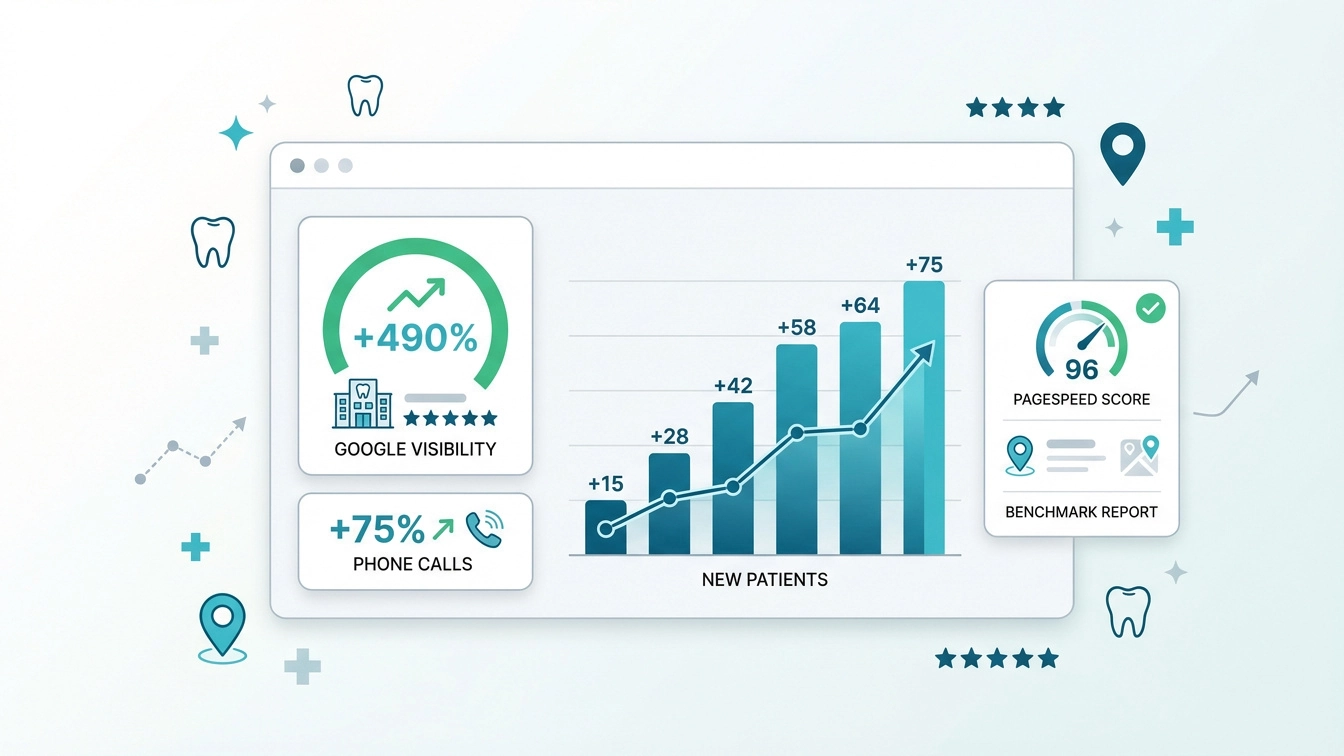
- Prioritize Page Speed & Mobile UX: Google reported that over half of mobile visitors leave if a web page takes longer than three seconds to load. We helped Aura Dental Centre in Winnipeg migrate their website to our high-speed hosting and optimized their technical performance to raise their Google PageSpeed score from 57% to 96%—helping drive a 75% increase in clinic phone calls within six months.
- Answer Practical Patient Questions Upfront: Clearly display accepted insurance plans, direct billing policies, Canadian Dental Care Plan (CDCP) eligibility, parking details, and emergency hours.
- Create Dedicated Treatment Pages: Instead of listing all procedures on one generic page, build standalone pages for high-value treatments like dental implants, Invisalign, sedation dentistry, and emergency dental care.
- Offer 24/7 Booking & AI Live Chat: Adding a PIPEDA-compliant live AI chat widget and online scheduling options lets patients book appointments outside office hours without waiting on hold.
2. Dominate Google Maps with Local Dental SEO
When Canadians search for “dentist near me” or “emergency dentist [city]”, the Google Maps Local Pack captures the majority of clicks and phone calls.
- Optimize Online Listings and Google Business Profile (GBP): Ensure your dental clinic name, address, phone number (NAP), hours, and service categories match your website exactly. Publish weekly Google Business updates featuring clinic news, seasonal oral health tips, and treatment highlights. We build and manage listings in one central hub.
- Target Specific Neighbourhoods: Rather than competing broadly across an entire metro area on day one, optimize your local content around the specific neighbourhoods and postal codes within a 5–10 km radius of your clinic. We helped Aura Dental Centre increase their local rankings near McPhillips Street in Winnipeg for high-value search terms, like emergency dentist and Invisalign, by publishing helpful oral guides optimized to North Winnipeg and dental ads with a geo-fence around their practice.
- Automate Patient Review Requests: Steady, recent 5-star reviews are one of the strongest ranking factors in Google Maps. Use automated post-visit SMS or email workflows to invite happy patients to leave feedback—while respecting provincial college rules against offering financial incentives for reviews. Manage and respond to reviews on over 200 platforms from one central hub.
3. Get Your Dental Clinic Recommended by AI Search (ChatGPT & Gemini)
Patient search habits have shifted. Alongside Google, Canadians increasingly ask ChatGPT, Google Gemini, Perplexity, and Microsoft Copilot questions like “Who is a good family dentist in Vancouver for nervous patients?”
Now, nearly all Canadians (89%) go online for health and healthcare information, and about 1 in 5 patients are using LLM-based chatbots to search for health information.
If you’re wondering how to get ChatGPT or Google Gemini to recommend your dental clinic to new patients, this is an emerging set of strategies known as Answer Engine Optimization (AEO) or Generative Engine Optimization (GEO), the evolution of Search Engine Optimization (SEO).
To earn recommendations from AI answer engines, like ChatGPT or Google Gemini, using SEO/AEO/GEO strategies, your online presence needs structured, verifiable authority:
- Publish Question-and-Answer Content: Add clear, concise FAQ sections to every treatment page that directly answer common patient concerns (e.g., recovery times, procedure steps, and insurance coverage).
- Showcase Dentist Credentials (E-E-A-T): AI engines prioritize content tied to verified medical professionals. Include detailed bios for every dentist and hygienist on your team, listing their degrees, university training, and provincial college memberships.
- Build Third-Party Citations: Maintain consistent listings across reputable Canadian healthcare directories (such as RateMDs, Opencare, and provincial dental association directories) so AI models can cross-verify your clinic’s reputation.
4. Capture Immediate Demand with Targeted Dental Google Ads
While SEO builds long-term organic authority over 3 to 6 months, Pay-Per-Click (PPC) Google Ads for dentists place your clinic at the very top of search results within days.
- Focus Budget on High-Intent & High-Value Keywords: Bid specifically on urgent and high-margin searches—such as “emergency toothache relief”, “Invisalign consultation”, or “all-on-4 dental implants”—rather than broad, low-intent terms.
- Use Strict Geo-Fencing: Restrict your dental ad impressions to a tight radius (e.g. 5-10 km) around your practice so you never pay for clicks from patients who live too far away to visit.
- Send Clicks to Matching Landing Pages: Never send paid ad traffic to your homepage. Match every ad group to a dedicated treatment landing page with a clear call-to-action and click-to-call button to maximize new patient bookings.
5. Navigate Canadian Privacy Laws & Provincial College Rules
Unlike general retail marketing, dental advertising in Canada is strictly regulated. Violating advertising standards can trigger costly complaints from your provincial regulatory body.
- Follow Provincial College Advertising Guidelines: Regulators such as the RCDSO (Ontario), College of Dental Surgeons of Alberta (CDSA), and BCCOHP (British Columbia) prohibit unverified superlatives (like claiming to be the “best” or “top” dentist), misleading before-and-after photos, and certain types of promotional giveaways. Always frame your messaging around factual expertise, patient comfort, and clinical education.
- Ensure PIPEDA, PHIPA, and HIA Compliance: Any website contact form, AI chatbot, CRM, or SMS reminder system that collects patient health details must comply with Canada’s federal PIPEDA law and provincial health privacy statutes (such as PHIPA in Ontario and HIA in Alberta).
6. Nurture Patient Retention with Automated Email & SMS
Acquiring a new patient costs significantly more than retaining an existing one. Automated communication keeps your hygiene schedule full year-round:
- Automated Recall & Hygiene Reminders: Send timely email and text reminders when patients are due for six-month checkups and cleanings.
- Educational Patient Newsletters: Share practical, clinically reviewed oral health guides that position your practice as a trusted resource rather than a sales pitch.
- Post-Visit Experience Surveys: Capture private patient feedback immediately after an appointment so your front desk can resolve minor issues before they turn into negative public reviews.
Review CASL (Canada’s Anti-Spam Legislation) rules to ensure your automated email and text message reminders are compliant with all regulations.

Four Common Dental Marketing Mistakes to Avoid in Canada
Even established dental clinics frequently lose thousands of dollars in wasted ad spend and missed patient bookings due to a few preventable missteps:
- Sending Google Ads Traffic to Your Homepage: When a patient searches for “Invisalign consultation” or “emergency root canal” and clicks your ad, landing on a generic homepage forces them to hunt for information. Always route paid clicks to a dedicated treatment landing page with a clear call-to-action and click-to-call button.
- Ignoring Phone Call Tracking & Front-Desk Follow-Up: Over 70% of dental inquiries still happen over the phone. Without dynamic call tracking and CRM lead alerts, clinics cannot tell which ads generate actual booked chairs—and inquiries that go unreturned for more than 60 minutes frequently book elsewhere.
- Overlooking Provincial Dental College Advertising Rules: Using superlative claims (such as “best dentist in Toronto”), publishing unverified patient testimonials, or running promotional contests (like free raffles) can violate advertising standards set by provincial regulators like the RCDSO (Ontario), CDSA (Alberta), and BCCOHP (BC).
- Relying on Broad Metro Targeting Instead of Local Neighbourhoods: Patients rarely drive 45 minutes across a major city for a routine cleaning. Concentrating your SEO and Google Ads within a targeted 5–10 km radius around your clinic consistently lowers your cost per patient acquisition.
Next Steps to Grow Your Dental Clinic with New Patients
If your appointment calendar has gaps—or you aren’t sure how visible your dental practice is on Google Maps and AI search—start with these three steps:
- Audit Your Local Visibility: Run a Free Dental Practice Checkup to see how your clinic ranks against nearby competitors on Google Search, Maps, and local directories.
- Fix Technical Bottlenecks: Test your current website on Google PageSpeed Insights and ensure mobile visitors can book an appointment in under three clicks.
- Partner with a Healthcare Specialist: Work with a team that understands Canadian dental regulations and tracks real ROI—measured in booked appointments rather than vanity clicks. Explore our Canadian Dental Marketing & Website Design Services today!
Frequently Asked Questions About Dental Marketing in Canada
How much should a dental clinic spend on marketing in Canada?
Your dental clinic’s marketing budget will vary depending on your business goals and maturity stage. According to the Business Development Bank of Canada (BDC), B2C (Business-to-Consumer) companies, like dental practices, spend between 5-10% of gross revenue on marketing.
But, the marketing budget varies depending on the maturity stage of their business: in our experience, many established Canadian dental clinics invest between 5% and 8% of gross revenue on dental marketing to maintain steady patient flow, while newer clinics or practices aggressively scaling high-value procedures (such as implants or orthodontics) often allocate 8% to 12%.
Rather than focusing strictly on monthly dental ad spend, track your Cost Per Acquisition (CPA) against the Lifetime Value (LTV) of a new dental patient to measure your marketing Return on Investment (ROI).
What is the difference between Local SEO and GEO for dentists?
Local SEO focuses on ranking your clinic in traditional search results and the Google Maps Local Pack when patients search terms like “dentist near me.” Generative Engine Optimization (GEO) structures your website’s clinical content, dentist credentials, and third-party directory citations so AI tools like ChatGPT, Google Gemini, and Perplexity recommend your practice when users ask conversational questions about local dental providers.
Are patient testimonials and before-and-after photos allowed on Canadian dental websites?
Rules vary by province, so dental clinics must follow their specific regulatory college guidelines. For example, Ontario’s RCDSO and Alberta’s CDSA enforce strict rules around patient testimonials, comparative claims, and clinical photography—requiring unedited, factual before-and-after images with documented patient consent. Working with a healthcare-specialized agency helps ensure your website and social media remain compliant.
How many new patients should a healthy dental practice attract per month?
For a solo general dentist, attracting 15 to 25 new patients per month typically offsets natural patient attrition and drives steady practice growth. Multi-chair clinics or group practices with multiple associates and hygienists generally target 30 to 60+ new patients monthly, depending on chair capacity and local competition.
Should a new dental startup focus on SEO or Google Ads first?
A new dental practice should launch Google Ads (PPC) first to generate immediate phone calls and fill the appointment book within 2 to 4 weeks, while simultaneously building out Local SEO and GEO in the background so organic traffic takes over as your primary, lower-cost patient channel within 4 to 6 months.